ARTnews celebrates the legacy of Black Mountain College
As the United States approaches its 250th anniversary, ARTnews launched a special feature in its long-running Art in America series. Rather than attempting to present a single narrative, this trusted source for global art news invited respected experts to write the history of American art through some of the terms that defined it, arranged from A to Z.
And “B” is for Black Mountain College.
Black Mountain College (1933–1957) was a highly influential liberal arts college on the shores of Lake Eden in Black Mountain, North Carolina. It was known for placing arts at the center of education and using progressive teaching methods. Founded by John A. Rice, it fostered interdisciplinary, democratic and experimental approaches, attracting avant-garde students and instructors.
Today, the Black Mountain College Museum + Arts Center in Asheville preserves the college’s legacy through exhibitions and educational programs, while the former campus is home to summer camps, retreats, special events, and festivals. The campus is sometimes open for tours, such as those held during the annual Black Mountain College Museum + Arts Center’s {Re}HAPPENING event.
{Re}HAPPENING 14 is Saturday, April 25th, 2026. Click for more information.
B is for Black Mountain College
by Eva Díaz for ARTnews
Reprinted directly from the source: artnews.com/list/art-in-america/features/american-art-history-a-to-z-1234775693/b-black-mountain-college
The college, which was located in the Blue Ridge Mountains near Asheville, North Carolina, from 1933 to 1957, “endures in the small but exceptional canon of profoundly unconventional places in America, sites in the cultural imagination where radical artistic innovation and vanguard social communitarianism fostered alternative visions of what creative, progressive, democratic culture can be,” Díaz writes.
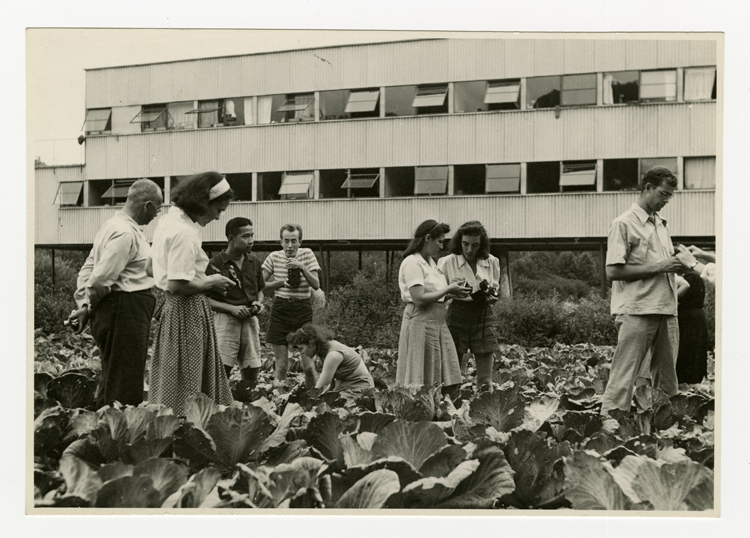
Source: ICA Boston (click for external link)
Black Mountain College endures in the small but exceptional canon of profoundly unconventional places in America, sites in the cultural imagination where radical artistic innovation and vanguard social communitarianism fostered alternative visions of what creative, progressive, democratic culture can be. If the college, located in the Blue Ridge Mountains near Asheville, North Carolina, from 1933 to 1957, was a “galaxy of talent,” to cite former student Ray Johnson’s semi-ironic description, it was also characterized by both bitter dispute and moments of evanescent harmony. The rigorous artistic practices and influential teaching methods that emerged at Black Mountain made it a home for crucial transatlantic dialogue between European modernist aesthetics and pedagogy and their postwar American counterparts.
Experimentation—and its close relative, interdisciplinarity—were key themes of this conversation. Seemingly everyone who attended Black Mountain College shared a desire to experiment, but they didn’t necessarily agree on what that meant. In particular, competing approaches to experimentation were advanced by three of the college’s most notable faculty members in its heyday: artist Josef Albers, composer John Cage, and architect-designer R. Buckminster Fuller. The models they explored—the creation of new forms of visual experience using methods of laboratory-like study imported from the Bauhaus (Albers); the organization of aleatory processes and acceptance of indeterminacy inspired by the Dadaists (Cage); and “comprehensive, anticipatory design science” in the service of a utopia of efficiently managed resources (Fuller)—were represented in projects as varied as geometric abstraction, serial and mass production, dome architecture, chance-based musical composition, and explorations of monochromatic painting.
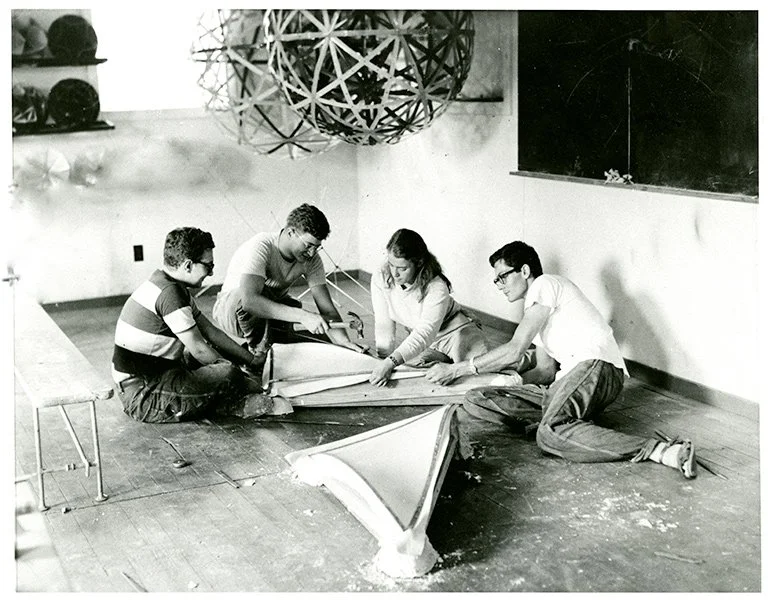
These types of “testing” were fostered by other Black Mountain luminaries such as Anni Albers and Merce Cunningham, as well as students including Kenneth Noland, Robert Rauschenberg, Dorothea Rockburne, Kenneth Snelson, and Cy Twombly. What drew such disparate figures together was a shared sense of countercultural ambition and an allegiance to avant-gardism, cultural improvement, and political progressiveness.
Black Mountain’s reputation for experimentation made it a touchstone in contemporary art and culture whose influence remains vital today. As does the importance of its aspirations in the fraught history of 20th and 21st-century art. After all, artists may not experiment so intensively if they perceive their current state of affairs as satisfactory.